 HS Info
UK Debit Cards Non GamStop Casinos 2026 — Visa & Mastercard
This page explains how UK-issued Visa and Mastercard debit cards work at non gamstop casinos. It covers acceptance, withdrawal, fees and disputes. Written for UK consumers, not for operators.
What changes for UK cards at non gamstop casinos
UK debit cards remain the most familiar deposit rail for British players considering non gamstop casinos. The rails themselves — Visa and Mastercard — do not change when the operator sits outside the UKGC framework. What changes is the layer of controls around them: no UKGC-driven affordability layer, no credit-card ban at the operator level, no automatic GamStop cross-check. For a full topic overview return to the non gamstop casinos homepage.
The card network cares about the merchant category code, the acquiring bank, and the fraud risk. The UK card issuer cares about its own risk appetite for gambling merchants and its regulatory obligations under the Financial Conduct Authority. Between them, they decide whether a given deposit clears. The offshore operator is only one of several actors, and often not the reason a payment fails.
Because Visa and Mastercard use the same scheme rules for a UK debit card whether the merchant is in London, Malta or Curacao, you keep the essential consumer protections built into those schemes: unauthorised-transaction chargeback rights, dispute resolution windows (typically 120 days from the transaction date), and standardised messaging on your bank statement. Those baseline protections do not replace the UKGC framework, but they are more than nothing.
One further nuance is important for UK consumers thinking about card deposits at offshore operators. The card scheme rules were written for retail commerce; gambling was added under specific merchant-category rules over time. When your bank flags a transaction as gambling MCC 7995 it does so based on the merchant descriptor set by the acquiring bank abroad. Occasionally a processor mis-flags a gambling transaction under a different category (retail, entertainment, digital services). That is against the scheme rules and, if you spot it, is worth raising with your card issuer — it may indicate a wider processor compliance issue.
The consumer-warning framing to keep in mind: the card is your money, but the operator is offshore-licensed. Even a technically flawless card transaction carries the wider risks of the offshore market. Read the operator’s licence details before you deposit, and treat the card deposit as a real transfer rather than a fun-money placeholder.
Visa Direct and Mastercard Send explained
Visa Direct and Mastercard Send are the “push to card” services used for withdrawals back to a debit card. They allow a merchant — in this case, the casino or its payment processor — to push funds to your debit card in near-real time, using the same rails that carry authorisations in the other direction. From your side it looks like a deposit reversal on your bank statement.
Not every non-UKGC operator supports Visa Direct or Mastercard Send. Setting up the push-to-card capability requires additional agreement with the acquiring bank, and some processors do not offer it. Where it is supported, card withdrawals settle in one to five working days, though the first-payout KYC review can add up to 72 hours at the start.
The fee position on a card withdrawal varies. Some operators absorb the network fee; others pass it on as a fixed £5-£10 charge, or as a percentage. The cashier terms should say. Do not assume free withdrawal to card unless it is spelled out.
The name “Visa Direct” refers specifically to Visa’s original credit-transfer service, launched in 2016 as Visa’s response to the growing demand for real-time card payouts. Mastercard’s equivalent is Mastercard Send, launched in 2015. Both services use the existing card scheme rails, so the actual money flow is familiar to acquiring banks and to card issuers. What is new is the direction — funds moving from merchant to cardholder rather than cardholder to merchant.
Merchant category codes and issuer blocking
Every card transaction carries a merchant category code — a four-digit number describing what the merchant sells. Online gambling MCC 7995 is the classic. UK issuers screen transactions by MCC and may block gambling MCCs to unlicensed-in-the-UK operators by default. That is not a technical fault; it is a deliberate risk control.
Barclays, Lloyds, HSBC and NatWest have all published gambling-block features in their mobile apps, allowing you to toggle gambling transactions off at the account level. That block is the customer’s own tool; enabling it and then trying to deposit will produce a decline. Some banks also block gambling MCCs by default on certain product tiers.
If your card is being declined at a non-GamStop operator, contact your bank directly. Do not attempt to change the merchant category code — that would be the merchant’s decision, not yours, and misrepresenting the MCC would be fraud on the acquiring bank. Better to accept the block as a signal and reconsider.
Consumer awareness of gambling MCC controls has grown since 2019, in part because UK banks now publish these controls in mobile app settings. Monzo, Starling and Revolut each let you toggle gambling transactions with a single tap. Barclays and HSBC require you to speak with support or use online banking. Whichever your bank, the block is bank-side and cannot be turned off by the operator. If you have previously enabled a gambling block and forgotten, that is the most likely reason your card is being declined.
Visa versus Mastercard: practical differences
For UK debit cards the two schemes are more similar than different, but there are a couple of practical points. Visa Direct is broadly better supported in the offshore casino market than Mastercard Send, so if you specifically want a card withdrawal a Visa debit may be a slightly safer bet. Mastercard has historically been quicker to update fraud rules; you may see more “3D Secure” challenges on a Mastercard than a Visa at the same operator.
Currency conversion fees also differ subtly. Visa and Mastercard publish their reference rates daily; the actual rate at the point of transaction includes a scheme mark-up plus the issuer’s mark-up. Total FX cost is usually 1.5% to 3% for a UK card converting to euro. Some challenger banks (Monzo, Starling, Revolut) apply lower FX mark-ups and can save 0.5% to 2% on a large deposit.
Prepaid Mastercards and virtual cards issued by e-money providers behave differently from full debit cards. They may be flagged separately by the operator’s fraud rules and may or may not be accepted. Check the cashier before funding.
The reality of currency conversion for a UK cardholder is worth walking through with an example. A £100 deposit into a euro-denominated cashier at a mid-market rate of €1.17 per £1 should credit €117. In practice, the bank rate applied is around €1.14, and the account credits closer to €114. On withdrawal back the same asymmetry applies. A round trip therefore costs 5-6% before you even play, which is more than most casinos’ house edge on slots. Consumers looking specifically at sterling-denominated non-GamStop operators avoid this drag, but the field is small and vetted more slowly.
Contactless-related fraud rules can also matter. Card-not-present transactions like online gambling deposits are outside contactless’s low-value exemption, which is why 3D Secure applies. If your bank has been sending you “we noticed unusual activity” alerts on regular non-gambling transactions, expect the same on a gambling deposit — and expect the same false-positive block rate.
Overview: the four rails on one page
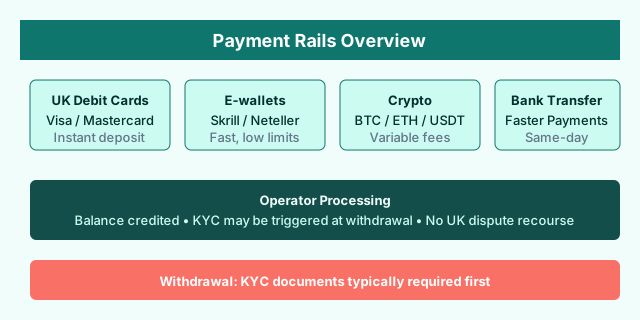
The diagram above places UK debit cards in the context of the other three rails you will see at a non-GamStop cashier: e-wallets, crypto and bank transfer. Debit cards are the default choice for most UK consumers because the money is theirs (not borrowed), the deposit is instant, and the statement is transparent. The trade-off is that card acceptance is patchy, and card withdrawals depend on whether the operator supports Visa Direct or Mastercard Send.
The one thing all four rails have in common is that KYC will still be triggered at the withdrawal step at any operator planning to remain in business. The rail changes the mechanics, not the eventual identity check. If you assumed that a card deposit would somehow avoid the KYC layer, that is a myth — the card issuer already knows your identity, the operator will still ask for its own documents.
Deposit limits, fraud checks and 3D Secure
UK debit cards are subject to Strong Customer Authentication under the FCA-implemented Payment Services Regulations. That means a 3D Secure step-up challenge on card-not-present transactions above the low-value exemption threshold. At the casino cashier this looks like a redirect to your bank’s app or a text-message code. The prompt is unavoidable and is not something the operator can turn off.
Operator-side deposit limits vary. A typical single-card deposit ceiling is £500-£5,000. Daily and monthly caps sit higher. The operator often runs its own fraud checks — velocity limits, IP checks, device-fingerprint rules — that may result in a declined deposit even after the bank has approved it.
If you hit a decline chain (bank approves, operator declines, or vice versa), the sensible response is to stop and use a lower amount, not to keep retrying. Repeated declines can result in the operator soft-blocking your account, which is annoying to unwind and may leave a small pending charge on your card that takes days to reverse.
A useful safeguard is to set your own low daily limit on the card itself, either through the bank’s app or by using a separate savings account and card that holds only a small balance. That way even a lapse in judgement cannot exceed the amount you have decided in a calmer moment is affordable to lose. Several UK banks now support per-merchant-category daily caps as a native feature.
What to look for in a UK-facing cashier
- A clear list of accepted card networks (Visa debit, Visa credit, Mastercard debit, Mastercard credit) rather than a vague “cards” label.
- Fee schedule for card deposits (usually 0% but sometimes 1-2.5%).
- Withdrawal-to-card support (Visa Direct or Mastercard Send) explicitly named.
- Currency of account (GBP, EUR, USD) and the conversion policy.
- Minimum and maximum single deposit values.
- Time to withdrawal for card payouts (should be under five working days after KYC).
- The dispute-resolution route in the terms and conditions.
Ideally the operator also publishes its licensing details (Curacao GCB, MGA or Anjouan) with a licence number, and a link to the licence register at the regulator. Absence of these details is a small warning sign.
Consumer rights and complaint routes
Your consumer rights on a UK debit-card transaction to any merchant are governed by the Payment Services Regulations 2017 (which implement the EU Payment Services Directive 2, PSD2), plus the scheme rules of Visa or Mastercard. Those rights apply whether the merchant is in the UK or offshore. They cover unauthorised transactions, non-delivery of goods, and technical errors in processing.
What they do not cover is a straight gambling loss where you deposited the money, played, and lost. The card scheme rules explicitly exclude “disputes over the outcome of a bet”. If the operator refuses a withdrawal, that is a different question — it may amount to non-delivery of a service and be chargeable, but the outcome depends on evidence and the specific scheme rule cited.
Complaint routes for UK consumers are: (1) the operator’s own complaints team first; (2) the offshore regulator (Curacao GCB, Anjouan or MGA) if the operator refuses to resolve; (3) your card issuer for scheme-level dispute; (4) the Financial Ombudsman Service, in limited cases, against your bank rather than the casino. There is no UKGC route because the operator has no UKGC licence.
Card acceptance and timing at a glance
| Card type | Deposit acceptance | Withdrawal support | Typical fee |
|---|---|---|---|
| Visa debit (UK) | High | Common via Visa Direct | 0-1% |
| Mastercard debit (UK) | High | Sometimes via Mastercard Send | 0-1% |
| Visa credit (UK) | Variable (issuer may block) | Rare | 0-2.5% |
| Mastercard credit (UK) | Variable (issuer may block) | Rare | 0-2.5% |
| Prepaid Mastercard | Sometimes accepted | Usually not supported | 0-3% |
| Virtual e-money card | Variable | Usually not supported | 0-3% |
These figures are guidance based on published cashier terms across the offshore market. Individual operators vary, and issuer decisions vary within each card type. Treat the table as a starting point for your own checking rather than as a definitive answer.
Frequently Asked Questions
Do all UK debit cards work at non GamStop casinos?
No. Some UK issuers block gambling merchant category codes to unlicensed operators. Others allow the transaction but flag it for review. Whether your specific card works depends on issuer policy, not the operator.
Is a debit-card deposit faster than a bank transfer?
Yes, on both ends. Deposits are instant and withdrawals via Visa Direct or Mastercard Send typically settle in one to five working days versus two to seven for bank transfer.
Can I get a chargeback on a debit-card gambling deposit?
Chargebacks for unauthorised transactions are possible under the Visa or Mastercard scheme rules, but a straightforward loss is not usually a chargeback event. Section 75 protection applies only to credit cards.
Why does my bank statement show a different merchant name?
The payment processor acting between the operator and the card scheme often uses a corporate name unrelated to the casino brand. This is normal in the offshore market.
What happens if my card is blocked at checkout?
You will see “declined by issuer” or a similar message. Contact your bank to check whether it applies a gambling-MCC block; do not attempt to obscure the merchant category to bypass the block.
Do card withdrawals go back to the same card?
Yes, in almost all cases. Visa Direct and Mastercard Send route funds back to the card that made the deposit, provided the operator supports card withdrawal.
Is there a maximum card deposit at non GamStop sites?
Yes, and it varies by operator and by processor. Typical single-transaction limits range from £500 to £5,000. Cumulative daily and monthly caps also apply.
Responsible Gambling
GamStop is a UK consumer-protection scheme; it exists to make self-exclusion durable. If you are looking at UK debit-card deposits at non-GamStop sites because your GamStop registration is limiting your access to UKGC-licensed operators, please pause before continuing. Card deposits move real money out of your current account, and offshore-licensed operators offer weaker recourse if things go wrong.
Support in the UK is available from GamCare (0808 8020 133), Gordon Moody, the NHS National Gambling Clinic, BeGambleAware, and GAM-Anon. Do not use borrowed money for gambling; do not chase losses; keep gambling funds separate from bill money.
Wider legal background is available in the Wikipedia entry for the UK Gambling Commission. UK residents may also be interested in the payments-consumer perspective on the Financial Conduct Authority gov.uk page.

Oliver Bennett
Payments Journalist at HS Info · Last updated 5 August 2026
Oliver has covered UK online-payment rails and their intersection with gambling regulation since 2018, focusing on consumer-side friction and dispute mechanisms. He writes for HS Info in a plain-English register aimed at UK consumers weighing offshore-licensed gambling platforms.