 HS Info
Crypto Non GamStop Casinos 2026 — Bitcoin, ETH, USDT
This page covers cryptocurrency at non gamstop casinos: which coins are supported, how fees and confirmations work, and why KYC still applies at withdrawal. Written by a UK payments journalist.
Crypto as a deposit rail at non gamstop casinos
Cryptocurrency is a fast-growing deposit rail at non gamstop casinos. The three coins in widest use are Bitcoin, Ethereum and stablecoin USDT, with a long tail of altcoins offered by some operators. For a wider payments overview see the non gamstop casinos homepage. Crypto deposits sidestep card-issuer blocks and do not appear on your bank statement as gambling, which is why they are popular in the offshore market. They introduce their own set of frictions, and this page is about those.
The essential mental model is this: you buy crypto from an exchange (Kraken, Coinbase, Bitstamp in the UK are the mainstream options), you hold it in a wallet (custodial on the exchange, or self-held in software or hardware), and you send it from that wallet to a one-time deposit address the casino gives you. The blockchain moves the coins, the casino credits a balance denominated either in the coin or in a fiat equivalent, and you play.
On withdrawal the process runs in reverse: you request a payout to your wallet address, the operator processes (usually after KYC on your first cash-out), and the coins arrive after network confirmation. Where the operator holds a fiat balance, you also incur a conversion spread on the way out, so the total round-trip cost of a crypto flow is higher than the deposit fee alone.
A subtlety worth calling out early is the difference between a self-held wallet (where you control the private keys) and a custodial wallet (where an exchange or third party controls the keys on your behalf). Casino deposits work the same way from either, but the security posture is very different. Self-held is more resilient to exchange failure but more exposed to your own mistakes. Custodial is convenient but exposes you to the exchange’s solvency. UK exchanges are covered by the Money Laundering Regulations but not by any deposit-guarantee scheme comparable to the FSCS for banks.
Bitcoin, Ethereum, USDT: how they differ
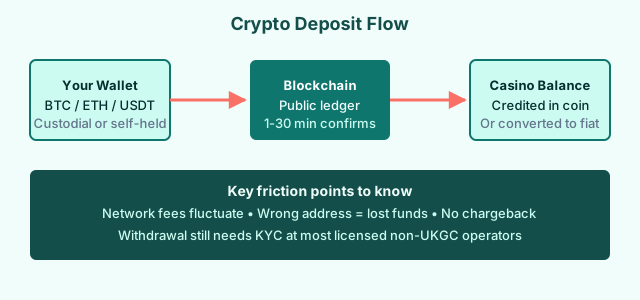
Bitcoin is the oldest and most widely accepted. Fee variance is the main practical issue: network fees can spike when the mempool is busy, and confirmations take longer. For casino deposits Bitcoin is workable if you accept 10-60 minute waits and fees anywhere from £1 to £15 depending on network conditions.
Ethereum settles faster in most conditions but its network fees on the base layer can also spike. USDT and USDC (stablecoins pegged to the US dollar) are the practical middle ground: fast, cheap on TRC-20 (Tron network) or on Ethereum layer-2 rollups, and price-stable in the sense that a USDT is expected to remain worth one dollar. Stablecoin holders are exposed to the credit risk of the issuer (Tether Limited for USDT), a separate matter worth understanding.
Some operators accept Litecoin, Dogecoin, Solana, Cardano and other tokens. Support varies. If you have a favourite coin, check the cashier before signing up rather than expecting universal support. Cross-chain support (moving a stablecoin between networks) can also cause confusion; sending USDT ERC-20 to a USDT TRC-20 deposit address will result in a lost transaction.
Layer-2 networks (Arbitrum, Optimism, Base, Polygon zkEVM) have grown in casino-deposit usage over 2024-2026. They offer near-instant confirmations and pennies-of-fee costs, and support the same stablecoins as the base Ethereum layer. Not every casino cashier supports layer-2 addresses yet; sending USDT on a layer-2 network to an address on the base layer will fail. Match the network label exactly before you send.
KYC still applies at withdrawal
The common misconception about crypto casinos is that they skip identity verification. In fact, at any operator planning to remain solvent and licensed, KYC applies at withdrawal just as it does for card and bank deposits. The operator’s obligation to its payment processors and to its regulator does not vanish because the deposit rail is crypto.
Typical KYC triggers for a crypto payout include: first withdrawal above a low threshold (often €100 to €500), cumulative deposit crossing an internal ceiling, source-of-funds requests on larger payouts, and automated flagging by transaction-monitoring software watching for typical laundering patterns. The documents requested are the same as for fiat: passport or driving licence, proof of address, sometimes a source-of-funds statement.
If the marketing on a site strongly emphasises no-KYC or full anonymity, treat it as a warning. Either the operator is at high AML risk, or it is not planning to pay meaningful withdrawals. In either case, depositing at such an operator is speculative at best.
Some crypto casinos publish an anonymous-play offer up to a low ceiling — sometimes €2,000 in aggregate withdrawals — before KYC applies. This is a marketing decision, not a legal one, and it does not mean the operator has no AML obligations. Above the ceiling the KYC requirement kicks in, and the operator may retroactively request documents on any accumulated balance. Do not depend on the anonymous ceiling for a strategy.
Network fees, confirmations and lost funds
Network fees are the amount you pay to miners or validators to include your transaction in the next block. They are separate from any fee charged by the casino or the exchange. Bitcoin fees are quoted in satoshis per vByte and can range from a few pence to twenty pounds during congestion. Ethereum fees are in gwei per gas unit; layer-2 networks (Arbitrum, Optimism, Base) reduce this by an order of magnitude.
Confirmations are network events. For a casino deposit the operator will usually credit after one to six confirmations, which takes a few minutes on Ethereum and up to an hour on Bitcoin. During heavy load, delays are longer and can be frustrating. You cannot speed up a transaction after it is sent; you can only pay a higher fee up front.
The largest single risk in crypto is sending to the wrong address. Blockchain transactions are irreversible, and there is no support line to reverse a mis-sent transfer. Copy addresses using the exchange’s copy button, double-check the first and last four characters, and consider sending a small test transaction first when using a new deposit address.
A worked example helps. Sending 100 USDT on TRC-20 costs around 1 USDT at current gas rates and confirms within a minute or two. Sending the same 100 USDT on ERC-20 during a busy Ethereum period can cost 5-10 USDT and take fifteen minutes. Both arrive at the same casino balance, but the ERC-20 route eats ten percent of the deposit in fees. This is why stablecoin choice at the network level is often more important than the choice of coin itself.
How UK exchanges fit into the flow
For a UK consumer, the crypto flow starts on an exchange. Kraken, Coinbase, Bitstamp, and Gemini are the mainstream FCA-registered options. You fund the exchange from a UK bank via Faster Payments or from a card, buy the coin, then either hold on the exchange or withdraw to a self-held wallet before sending to the casino.
The FCA registration is important. The FCA maintains a register of crypto-asset businesses under the Money Laundering Regulations 2017; using a registered exchange gives you a UK-facing regulatory relationship. It does not make crypto trading “safe” in an investment sense; it means the exchange has met AML requirements.
Some UK banks decline card payments to crypto exchanges, or set a low weekly limit for crypto purchases. Challenger banks tend to be more permissive. If your bank blocks a crypto purchase, that is your bank’s policy and not the exchange’s decision. Speak to your bank directly if you need clarity.
UK exchanges also apply transaction-monitoring rules that can flag outbound transfers to certain wallet addresses. If the casino’s deposit wallet has been flagged in the past, the exchange may block or delay the withdrawal even though your account is fully verified. Where this happens, the exchange usually will not tell you which wallet is flagged; you will simply see the transaction stuck in review. Some UK consumers work around this by withdrawing crypto to a self-held wallet first and sending from there, which shifts the flag risk to a wallet you control.
Volatility and price movement risk
Crypto prices move. A £200 deposit in Bitcoin may be worth £190 or £210 by the time it arrives, and the fiat balance on the casino side may differ from the fiat value at the moment you sent the coin. Some casinos credit balances in the coin itself; others convert immediately to a fiat balance and lock the value. Both approaches have consequences.
If the balance is coin-denominated, your gambling exposure is coin-plus-house-edge: you may lose to price movement even without placing a bet. If the balance is fiat-denominated, you avoid the price risk on the deposit but you also lose any upside on the coin. When withdrawing, the reverse applies: you may be converting back to coin at a different price.
Stablecoins substantially reduce this risk. USDT and USDC are designed to hold their peg to the US dollar. That still leaves the sterling-to-dollar FX rate as a small variable, but the coin itself does not move. For most UK consumers who see crypto purely as a payment rail rather than an investment, USDT on a cheap network is the pragmatic choice.
Chargebacks and disputes with crypto
There are no chargebacks on the blockchain. Once you send crypto, the transaction settles and cannot be reversed. If the casino refuses your withdrawal, you cannot recover the deposit through the card scheme rules, because there is no card scheme in the path.
Practical dispute options for a crypto deposit are limited to: the operator’s own complaints process, escalation to the offshore regulator (Curacao GCB, Anjouan, MGA), and public visibility (posting the dispute on a forum, though this is a weak lever). If the exchange you used has AML systems that flagged an outbound transfer as suspicious, it may in theory freeze coins mid-flow, but this is exceptional.
The takeaway is a stronger version of the general non-GamStop caution: treat every crypto deposit as an amount that may not be recoverable. The rail has more consumer-side friction than card deposits precisely because the safety net is thinner.
UK tax on crypto casino activity
UK gambling winnings are not subject to UK income tax and have not been since 2001. That applies regardless of whether the operator holds a UKGC licence. However, the crypto layer introduces a separate tax consideration: disposals of crypto assets can be a Capital Gains Tax event.
The HMRC framework treats depositing crypto into a casino as a disposal for CGT purposes. If your coins have appreciated between purchase and deposit, the gain is taxable above the annual allowance (£3,000 for the 2024-25 tax year, subject to change). Losses are allowable and can offset gains. Withdrawals also count as acquisitions at the value on the day of receipt, resetting the base cost for future disposals.
The practical implication is that a large crypto gambling flow can create tax admin even when you have no net win. Keep records of every deposit and withdrawal with the coin, the amount, the fiat value on the day, and the counterparty. HMRC guidance on crypto is published on the gov.uk site and updated periodically.
Coin comparison at a glance
| Coin | Typical network fee (UK £) | Typical confirmation | Volatility | Casino acceptance |
|---|---|---|---|---|
| Bitcoin (BTC) | £1 - £15 | 10-60 min | High | Universal |
| Ethereum (ETH) | £0.30 - £12 | 15 sec - 5 min | High | Very common |
| USDT (TRC-20) | £0.50 - £1.50 | 1-3 min | Low | Common |
| USDT (ERC-20) | £0.50 - £10 | 15 sec - 5 min | Low | Common |
| Litecoin (LTC) | £0.10 - £0.50 | 2-15 min | Medium | Some |
| Dogecoin (DOGE) | £0.10 - £0.30 | 1-5 min | High | Some |
These are indicative ranges for typical UK usage in 2026. Fees fluctuate materially with network conditions.
Frequently Asked Questions
Are crypto deposits genuinely anonymous?
No. UK crypto exchanges apply KYC before you can withdraw coins to a personal wallet, and the operator will still require KYC at cash-out. The blockchain is public and can be linked to identities.
Which coin has the lowest fees?
USDT on the TRC-20 network usually has the lowest network fees. Bitcoin (BTC) and Ethereum (ETH) can be more expensive during congestion, though Ethereum layer-2 networks reduce cost.
What if I send crypto to the wrong address?
The funds are gone. There is no reversibility on blockchain transactions. Always copy the deposit address and verify the first and last four characters before sending.
Do UK banks block crypto exchange purchases?
Some do. UK banks apply their own risk appetite to crypto exchanges. Where blocked, you may need to use a different bank or a challenger with crypto-friendly policy.
Is Bitcoin faster than Ethereum for casino deposits?
Not necessarily. Bitcoin confirmations can take ten minutes to an hour; Ethereum is faster during off-peak but slower during congestion. Stablecoins on TRC-20 are usually fastest for casino purposes.
Do I still pay UK tax on crypto casino winnings?
Gambling winnings themselves are not subject to UK income tax. However, disposals of crypto assets can trigger Capital Gains Tax if you profit on the value change between buying and depositing.
Can the operator freeze my crypto balance?
Yes. The balance credited to your casino account is a book-entry with the operator, not a self-held wallet. If the operator suspects fraud or fails KYC, it can freeze the balance.
Responsible Gambling
Crypto strips away some of the friction on the deposit side that acts as a natural brake on impulsive spending. That makes it particularly worth pausing over if your reason for looking at non-GamStop casinos is a personal difficulty with gambling control. GamStop remains a legitimate protective tool; overriding it by moving to offshore-licensed operators is unlikely to make things easier over time.
UK support is available from GamCare (0808 8020 133), Gordon Moody, the NHS National Gambling Clinic, BeGambleAware and GAM-Anon. Practical harm-reduction rules apply harder in the crypto context: set a hard cap before you start, keep gambling money separate, and never use borrowed money.
Background reading on UK crypto regulation is available in the Wikipedia entry on UK crypto regulation and in the Money Laundering Regulations 2017.

Oliver Bennett
Payments Journalist at HS Info · Last updated 5 August 2026
Oliver has covered UK online-payment rails and their intersection with gambling regulation since 2018, focusing on consumer-side friction and dispute mechanisms. He writes for HS Info in a plain-English register aimed at UK consumers weighing offshore-licensed gambling platforms.