 HS Info
Fast Withdrawal Non GamStop Casinos 2026 — Real Timings
This page explains fast withdrawal at non gamstop casinos: what the timing figures actually mean, why first payouts are slower, and how disputes work. Written for UK consumers by a payments journalist.
Real-world timing on fast withdrawals
“Fast withdrawal” is a heavily used marketing phrase across non gamstop casinos. The reality is that speed depends on three variables in sequence: the operator’s internal processing time, the KYC review on your first payout, and the settlement time of the payment rail you chose. Only the third of these is a technical matter; the other two are policy and staffing choices at the operator. For a wider payments overview see the non gamstop casinos homepage.
Operators that advertise instant or one-hour withdrawals are usually referring to the third variable in isolation and assuming a verified account. On your very first payout, add 24 to 72 hours for KYC review. On a busy weekend, add another day. Realistic total time from clicking “withdraw” to seeing funds is therefore usually one to five working days on your first cash-out at any operator, regardless of the marketing headline.
Where headline timings are accurate is on the second and subsequent payouts, once your account is fully verified. At that point an e-wallet withdrawal really does clear in a few hours, and a crypto withdrawal really does settle within a day. The lesson is not that operators are lying — some are quite accurate for verified accounts — but that the first payout is a KYC event, not a technical event.
One useful mental model is to think about withdrawals in two clocks: the operator clock and the network clock. The operator clock covers KYC review, internal approval, and the pending-window if any. The network clock covers the payment rail settlement time. Marketing speed claims almost always describe the network clock alone. Your first payout runs on the operator clock; your subsequent payouts run mostly on the network clock. Once you have that two-clock split in your head, the “why is my withdrawal slower than the advert” question usually answers itself.
KYC at withdrawal is the chokepoint
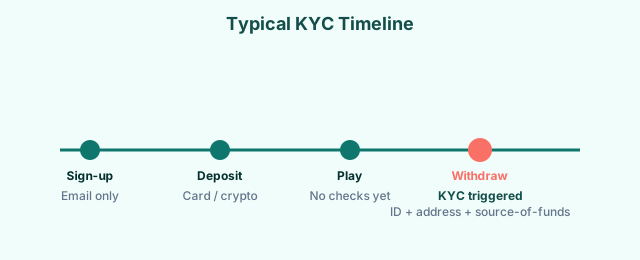
Every reputable non-UKGC operator applies KYC at some point. The question is whether it happens at sign-up (which slows deposits but speeds first withdrawal) or at first withdrawal (which speeds deposits but slows first cash-out). The offshore norm is the second pattern — delayed KYC — because it maximises the deposit conversion rate.
Documents you will need to send: a clear colour photo of your passport photo page or driving licence card, a proof of address dated within three months (utility bill, bank statement, tax document), and, on higher-value withdrawals, a source-of-funds statement showing where the deposit money came from. Some operators also do a selfie-plus-ID liveness check.
Timing on review is typically 24-72 hours for a straightforward set of documents. Delays happen when a document is blurred, when the address on the utility bill does not match the address on the ID, or when the ID country is not one the operator’s KYC provider recognises. Send high-resolution scans, use the exact document names the cashier asks for, and expect at least one back-and-forth on your first payout.
A tip worth passing on: KYC providers used by non-UKGC operators often reject documents that a UKGC operator would accept without comment. Colour photographs are essential; monochrome scans are frequently rejected. Bills that show a different address to the ID are rejected even for people who have recently moved. Sending a full-quality PDF straight from a bank’s online-statement download is more reliable than a phone photo of a screen.
Method-by-method withdrawal speed
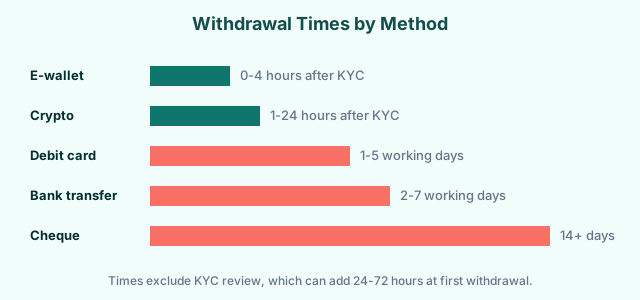
The chart summarises the practical differences. E-wallet payouts (Skrill, Neteller, MuchBetter) are almost always fastest once KYC clears — often a few minutes to four hours. Crypto is next, taking one to twenty-four hours depending on the coin and network conditions. Card withdrawals via Visa Direct or Mastercard Send take one to five working days. Bank transfers take two to seven working days depending on how the operator routes the correspondent-banking chain.
Cheques and courier delivery are still occasionally offered for very large payouts — usually above €10,000 — and are slow (two to four weeks) and expensive. Very few UK consumers ever need this rail.
Note that in every case the rail speed does not include the operator’s internal “pending” time. Some operators impose a 24-hour pending window during which you can cancel the withdrawal and put the funds back into play. That window is designed to encourage reversal and is worth turning off in your account settings if the operator allows.
Where operators run their own crypto-payout desks (rather than routing through a third-party processor), the timing can be even faster — sometimes fifteen minutes to an hour. But the payout depends on hot-wallet liquidity at the operator, which can be constrained on a busy day. If a crypto withdrawal is pending for hours, that is often the reason: the operator’s hot wallet is drained and a manual top-up is needed.
When a fast withdrawal is not fast
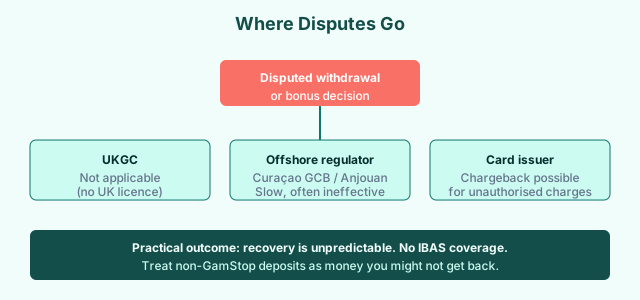
Occasionally a fast withdrawal turns into a slow withdrawal, or into no withdrawal at all. The causes are usually one of: KYC document rejection, a bonus-terms dispute (wagering not met, forbidden game played, restricted country), an anti-money-laundering flag, or a technical processor issue.
Practical response steps: keep every communication in writing (email over chat), take screenshots of the cashier state at the moment of withdrawal, request a written explanation from support, set a mental deadline of ten working days for resolution, and escalate through the operator’s formal complaints process if the deadline slips.
Where the operator refuses or ignores the complaint, external routes are: the offshore regulator (Curacao GCB has an online complaints form; Anjouan and MGA have their own), and the card issuer for card deposits (Section 75 for credit-card users, general chargeback rules for debit). Recovery is not guaranteed.
Bonus terms and wagering-requirement blocks
The single most common cause of a “fast” withdrawal being refused is that the underlying deposit was tied to a bonus with wagering requirements that were not met. Non-GamStop operators frequently offer large welcome bonuses (100% to 500% match, sometimes with free spins) precisely because the wagering conditions attached mean most of the value stays with the house.
Typical wagering requirements are 35x to 60x the bonus amount, sometimes 60x the deposit plus bonus. Game contribution varies: slots contribute 100%, table games often 10% or 0%, live dealer usually 5-10%. If you play the wrong game during the wagering phase the bonus is voided and any winnings are removed. Withdrawal attempts against unmet wagering are refused as a matter of course.
To avoid this trap, either play without a bonus (many operators support this), or read the wagering terms in full before accepting. If you accept a bonus, treat the total balance as bonus-locked until the wagering counter shows completion.
Wagering-linked withdrawal refusals are the single largest source of disputes at non-GamStop operators. In our reading of the offshore complaint databases, roughly forty percent of unresolved complaints trace back to a bonus term the player did not fully understand at the time of accepting. That is not necessarily the operator’s fault legally — the terms are usually visible in the cashier — but it is the operator’s design choice to make the terms so long and dense.
Pending withdrawals and reverse-payout traps
Many non-GamStop operators impose a pending window on withdrawals — anywhere from a few hours to 72 hours — during which you can cancel the withdrawal and return the funds to your playable balance. This is not a technical necessity. It is a retention mechanism designed to give impulsive gamblers the option to reverse a decision to cash out.
The trap is that the reversal is exactly when a returning-to-play decision is most emotionally driven. If you have decided to withdraw £500 after a good session, the 24-hour pending window is when the temptation to put it back into play is strongest. Turning off the reversal option in account settings, where the operator allows, is a small but useful piece of self-discipline.
Some operators do not allow reversal to be disabled and simply reduce the pending window if you email support. Others impose the pending window as an unchangeable term. If pending-reversal terms are important to you, check them before choosing an operator.
Account settings that speed up cash-out
- Enable two-factor authentication on the casino account before you attempt to withdraw. It reduces the risk of an in-flight compromise.
- Complete KYC documents proactively rather than waiting for the withdrawal to force it. Some operators allow document upload from day one.
- Set the account currency to sterling if the operator supports it, to avoid an FX spread on the way out.
- Turn off promotional emails so bonus offers do not tempt you into a wagering-locked balance.
- Confirm the payout rail supports your target amount — e-wallets often cap at £5,000 per transaction.
- Note the operator’s cash-out cut-off time for the day; a request submitted after the cut-off waits until the next processing window.
- Keep an eye on session times — withdrawals submitted on Friday evening rarely clear before Monday.
Not all operators expose these settings clearly. If a setting is not visible in your account, email support and ask; that also creates a paper trail if anything goes wrong later.
Payment processors and their role in speed
The payment processor is the party that actually moves money between the operator and your bank or wallet. Different processors have different speed profiles, and the processor is often invisible to the consumer — you only see the operator name on the cashier and the processor name on your statement.
Some processors specialise in fast card payouts via Visa Direct or Mastercard Send. Others focus on bank transfer, or crypto conversion, or e-wallet routing. When a casino switches processor (which happens more often than consumers realise, as acquiring banks rotate their gambling merchants), the cash-out timing can change materially. If you notice your withdrawals suddenly slower or faster than usual, a processor change is a likely explanation.
You cannot influence which processor the operator uses. What you can influence is the payment method you pick. E-wallets are less exposed to processor variation because they run their own end-to-end rail; card and bank transfer are more exposed because they depend on the processor plus the acquirer.
Where the operator publishes its processor list openly, that is a small credibility signal. Operators that will not name the processor are usually running higher-risk arrangements. If your withdrawal fails and the operator support cannot even name the processor to escalate to, that is telling you something about the arrangement.
Withdrawal time expectations
| Method | First withdrawal (with KYC) | Subsequent withdrawals | Typical minimum | Typical maximum |
|---|---|---|---|---|
| Skrill / Neteller | 24-72 hours | 0-4 hours | £10 | £5,000 per transaction |
| MuchBetter | 24-72 hours | 0-4 hours | £10 | £5,000 per transaction |
| Crypto (BTC/ETH/USDT) | 24-72 hours | 1-24 hours | £20 equivalent | None or very high |
| Visa Direct | 2-6 working days | 1-5 working days | £20 | £5,000 per transaction |
| Mastercard Send | 2-6 working days | 1-5 working days | £20 | £5,000 per transaction |
| Bank transfer (Faster Payments/SEPA) | 3-8 working days | 2-7 working days | £50 | Very high |
| Cheque / courier | 2-4 weeks | 2-4 weeks | £500 | Very high |
Times assume you have submitted correct KYC on the first request. Weekend and bank holiday effects apply to card and bank transfer only.
Frequently Asked Questions
What is the fastest withdrawal method?
E-wallets (Skrill, Neteller, MuchBetter) are usually fastest, settling within a few hours once KYC clears. Crypto is next-fastest.
Why is my first withdrawal slower than the marketing says?
Because your first withdrawal triggers KYC, which is a manual review that typically takes 24-72 hours. Subsequent withdrawals are faster because you are already verified.
Can I skip KYC by withdrawing small amounts?
Not for long. Operators cumulate deposits and withdrawals over time. Even small payouts will eventually trigger KYC once you cross an internal threshold. Any operator that never triggers KYC has larger problems.
What documents will I need for KYC?
A colour photo of a passport or driving licence, a proof of address dated within three months (utility bill or bank statement), and, for larger amounts, a source-of-funds statement.
What if the operator delays my withdrawal beyond the stated time?
Contact support in writing, keep a paper trail, and if the delay exceeds ten working days consider escalating to the offshore regulator or your card issuer.
Do bank holidays slow down withdrawals?
Yes, for card and bank-transfer withdrawals. Crypto and e-wallets are less affected because they run outside the UK banking clock.
Can the operator refuse a withdrawal on bonus terms?
Sometimes yes, if wagering requirements are unmet or bonus conditions were breached. Read bonus terms before accepting any offer.
Is there any real UK-side recourse for a delayed payout?
Limited. UKGC and IBAS do not apply. Your options are the offshore regulator, the card issuer for card deposits, and the Financial Ombudsman Service in very narrow cases involving your bank rather than the casino.
Responsible Gambling
Fast withdrawal is a marketing hook, and there is nothing wrong with wanting to see your money quickly. But if the reason you are drawn to non-GamStop operators is that they process withdrawals faster than a UKGC operator that stopped you playing, the underlying reason for the block deserves attention. GamStop is a UK consumer-protection scheme and it works by design; the speed argument is not a good enough reason to override it.
Support in the UK is available from GamCare (0808 8020 133), Gordon Moody, the NHS National Gambling Clinic, BeGambleAware and GAM-Anon. Set a hard withdrawal-back-to-bank rule for wins so that money does not stay in the casino balance where it can be re-staked.
Background on UK banking-payments consumer protections is in the Wikipedia entry on the Payment Services Regulations 2017 and in the Regulations themselves on legislation.gov.uk.

Oliver Bennett
Payments Journalist at HS Info · Last updated 5 August 2026
Oliver has covered UK online-payment rails and their intersection with gambling regulation since 2018, focusing on consumer-side friction and dispute mechanisms. He writes for HS Info in a plain-English register aimed at UK consumers weighing offshore-licensed gambling platforms.